Each Kingdom Requires a Lord — Whose Will Reign?

Each Kingdom Requires a Lord – Whose Will Reign? 

By Genevieve Kineke on

A few pages of Jesus of Nazareth: From the Baptism in the Jordan to the Transfiguration, by Pope Benedict XVI, has highlighted for me some troubling trends in the Church. He sifts carefully through Catholic thought as it differed historically from extra-ecclesial trajectories, but what must concern today’s reader is that many influential leaders in the Church have accepted non-Catholic premises in their views of the world.

In his explanation of the Kingdom that Jesus preached, Benedict reminds us that Origen had two basic thoughts on the topic. First was that Jesus himself is the “autobasileia, that is the Kingdom in person … the Kingdom is not a thing, it is not a geographical dominion like worldly kingdoms” (p. 49). In this way, those who come to know Christ Jesus come to know God who dwells among them, and who wishes his divine will to prevail.

Origen didn’t stop there, though. He insisted that not only does God dwell with his creatures, but He dwells in them. In a mystical way, it is understood that “man’s interiority [is] the essential location of the Kingdom of God”. And Benedict quotes from Origen’s On Prayer:

“Those who pray for the coming of the Kingdom of God pray without any doubt for the Kingdom of God that they contain in themselves, and they pray that this Kingdom might bear fruit and attain its fullness. For every holy man it is God who reigns … So if we want God to reign in us, then sin must not be allowed in any way to reign in our mortal body … Then let God stroll at leisure in us as in a spiritual paradise and rule in us alone with his Christ” (p. 50).

The two images are not contradictory, but layered, so that Jesus is the kingdom, and Jesus is in the man of virtue, so as that man grasps the grace offered through the passion of Christ, he is both more Christlike and the garden where Christ can reign.

Subsequently, Benedict shows that traditionally there is a third image of the Kingdom, which is the Church:

To be sure, neither the interpretation in terms of man’s interiority nor the connection with Christ ever completely disappeared from sight. But nineteenth- and early twentieth-century theology did tend to speak of the Church as the Kingdom of God on earth; the Church was regarded as the actual presence of the Kingdom within history (p. 50).

Then Benedict explains that the Enlightenment sparked specific trends that proved antithetical to this traditional understanding. There was the radical individualism championed by Adolf von Harnack, and the corollary belief that morality was more important than ritual. Others preferred to see the kingdom in more communitarian terms, pitting ethics against sheer grace, and all of these efforts were upended by Albert Schweitzer’s book, Jesus’ Proclamation of the Kingdom of God. His thesis was still tied firmly to the notion of God and the saving work of Christ, but it was far more eschatological in the sense that it was “a proclamation of the imminent end of the world, of the inbreaking of a new world where, as the term kingdom suggests, God would reign” (p. 52).

Surely the trauma of the First World War led many believers to wonder what place such massive blood-letting among Christians meant in the unfolding of world history, but the accompanying trains of thought went wildly off-course from that point.

Since that time, a secularist reinterpretation of the idea of the Kingdom has gained considerable ground, particularly, though not exclusively, in Catholic theology. This reinterpretation propounds a new view of Christianity, religions, and history in general, and it claims that such radical refashioning will enable people to reappropriate Jesus’ supposed message (p. 53).

Previous shifts of emphasis were not nearly as dangerous theologically as that final lie, which carries the sympathetic soul from a generic theocentrism to regnocentrism without God. And yet that is where we are today in much of the world, ‘where peace, justice, and respect for creation are the dominant values” (p. 54). How many times have we bit our tongues not to “proselytise” (the name of Jesus being so “divisive,” or the boundaries of the Church appearing so threatening)? Benedict acknowledges the temptation:

This sounds good; it seems like a way of finally enabling the whole world to appropriate Jesus’ message, but without requiring missionary evangelisation of other religions. It looks as if now, at long last, Jesus’ works have gained some practical content, because the establishment of the “Kingdom” has become a common task and is drawing nigh (p. 54).

But Benedict ultimately decries this utopian approach which removes God from the mission. The politicisation of the kingdom has marginalised religion, which already must genuflect to the state in so many settings. “This post-Christian vision of faith and religion is disturbingly close to Jesus’ third temptation [in the desert]” (p. 55).

We must keep this in mind as we consider how we approach all government promises in the near future. We see clearly the dangers of hoping that “princes” will advance our pet causes, for those power-brokers can turn on a dime and leave the Christian empty-handed. We must also recognise the dangers of ecumenical endeavors that rejoice in works that are mute about the faith that motivates them. We’ve attempted to baptise so much in the name of tolerance and compassion that we run the risk of losing the meaning of the very names in which we baptise.

Benedict summarises:
When Jesus speaks of the Kingdom of God, he is quite simply proclaiming God, and proclaiming him to be the living God, who is able to act concretely in the world and in history and is even now so acting. He is telling us: “God exists” and “God is really God,” which means that he holds in his hands the threads of the world … “Kingdom of God” is therefore an inadequate translation. It would be better to speak of God’s being Lord, of his lordship (pp. 56-57).

In an upside world where androgyny is to be preferred to man and woman, and “toxic masculinity” is thought to be at the heart of all our woes, we would do well to remember that Lordship has its place–both in the Son of God and those particularly called to live in persona Christi. Kingship carries within it many layered meanings, but primarily the understanding that hierarchy is preferred to mob rule, that sin corrodes the community, and a material kingdom is not what we seek. We cannot allow either the language to be diluted or the mission to be derailed, for Christ must be Lord, now and forever. Amen!
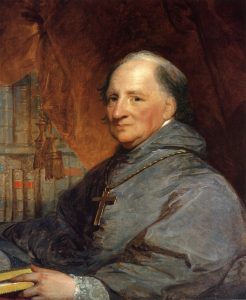
Archbishop John Corrolls’ – Prayer for Government

JohnCarrollGilbertStuart-1An Independence Day Prayer

We pray, O almighty and eternal God, who through Jesus Christ has revealed thy glory to all nations, to preserve the works of your mercy, that your Church, being spread through the whole world, may continue with unchanging faith in the confession of your name.

We pray Thee, who alone are good and holy, to endow with heavenly knowledge, sincere zeal and sanctity of life, our chief bishop, the pope, the vicar of Our Lord Jesus Christ, in the government of his Church; our own bishop, all other bishops, prelates and pastors of the Church; and especially those who are appointed to exercise among us the functions of the holy ministry, and conduct your people into the ways of salvation.

We pray O God of might, wisdom and justice, through whom authority is rightly administered, laws are enacted, and judgment decreed, assist with your Holy Spirit of counsel and fortitude the president of these United States, that his administration may be conducted in righteousness and be eminently useful to your people over whom he presides; by encouraging due respect for virtue and religion; by a faithful execution of the laws in justice and mercy; and by restraining vice and immorality.

Let the light of your divine wisdom direct the deliberations of Congress, and shine forth in all the proceedings and laws framed for our rule and government, so that they may tend to the preservation of peace, the promotion of national happiness, the increase of industry, sobriety and useful knowledge; and may perpetuate to us the blessing of equal liberty.

We pray for his excellency, the governor of this state, for the members of the assembly, for all judges, magistrates, and other officers who are appointed to guard our political welfare, that they may be enabled, by your powerful protection, to discharge the duties of their respective stations with honesty and ability.

We recommend likewise, to your unbounded mercy, all our brethren and fellow citizens throughout the United States, that they may be blessed in the knowledge and sanctified in the observance of your most holy law; that they may be preserved in union, and in that peace which the world cannot give; and after enjoying the blessings of this life, be admitted to those which are eternal.

Finally, we pray to you, O Lord of mercy, to remember the souls of your servants departed, who are gone before us with the sign of faith and repose in the sleep of peace; the souls of our parents, relatives and friends; of those who, when living, were members of this congregation, and particularly of such as are lately deceased; of all benefactors who, by their donations or legacies to this Church, witnessed their zeal for the decency of divine worship and proved their claim to our grateful and charitable remembrance. To these, O Lord, and to all that rest in Christ, grant, we beseech you, a place of refreshment, light and everlasting peace, through the same Jesus Christ, Our Lord and Savior.

Amen.


St. Joseph and Our Lady of America

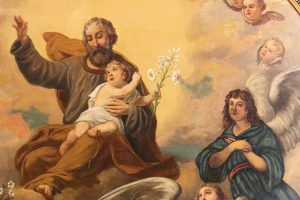
St Joseph MuralFrom the article by Dr M Marivalle  www.markmiravalle.com

The revelation from Joseph, if authentic, could well be the most important associated with this hidden saint and may indicate an era in which he will take a much larger role. It is the first time we know of that he too is described as a “co-redemptor” and seems to place that title in a new context.

“My heart suffered with the hearts of Jesus and Mary,” said Joseph in 1956. “Mine was a silent suffering, for it was my special vocation to hide and shield, as long as God willed, the Virgin Mother and Son from the malice and hatred of men. The most painful of my sorrows was that I knew beforehand of their passion, yet would not be there to console them. Their future suffering was ever present to me and became my daily cross. I became, in union with my holy spouse, co-redemptor of the human race. Through compassion for the sufferings of Jesus and Mary I cooperated, as no other, in the salvation of the world.”

Joseph allegedly added that “immediately after my conception, I was, through the future merits of Jesus and because of my exceptional role of future virgin-father, cleansed from the stain of original sin. I was from that moment confirmed in grace and never had the slightest stain on my soul. This is my unique privilege among men.

“Mine was perfect obedience to the Divine Will, as it was shown and made known to me by me by the Jewish law and religion,” Joseph allegedly said. “To be careless in this is most displeasing to God and will be severely punished in the next world. Let fathers also imitate my great purity of life and deep respect I held for my Immaculate spouse. Let them be an example to their children and fellow men, never willfully doing anything that would cause scandal among God’s people.

“I desire souls to come to my heart that they may learn true union with the Divine Will,” said Joseph.

The saint was said to have also appeared above a globe with clouds swirling about it, his hands similar to those of a priest during Mass, his eyes looking up as if in ecstasy. “Jesus and Mary desire that my pure heart, so long hidden and unknown, be now honored in a special way,” said Joseph, who told Sister Mildred that he had been appointed the Pope’s special protector and asked for a new devotion. “Let my children honor my most pure heart in a special manner on the First Wednesday of the month by reciting the joyful mysteries of the Rosary in memory of my life with Jesus and Mary and the love I bore them, the sorrow I suffered with them. Let them receive holy Communion in union with the love with which I received the Savior for the first time and each time I held Him in my arms.”

This Wednesday the 1st Wednesday of the month!


Our Lady of America’s final message to Sr. Mary – In the winter of 1984

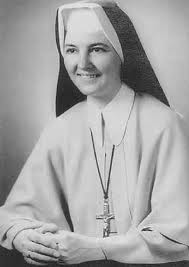
Sister Mildred Neuzil

Our Lady of America’s final message to Sr. Mary
In the winter of 1984 Our Lady came to Sr. Mary Ephrem with this final message:
“What happens to the world depends upon those who are living in it. There must be much more good than evil prevailing in order to prevent the holocaust that is so near approaching. Yet I tell you, My daughter, that even should such a destruction happen because there were not enough souls who took My warnings seriously, there will remain a remnant untouched by the chaos who, having been faithful in following Me and spreading My warnings, will gradually inhabit the earth again with their dedicated and holy lives. These souls will renew the earth in the power and light of the Holy Spirit, and these faithful children of Mine will be under My protection, and that of the Holy Angels, and they will partake of the life of the Divine Trinity in a most remarkable way. Let my dear children know this, precious daughter, so that they will have no excuse if they fail to heed my warnings.”

Another new testimony of healing

Another new testimony of healing

From the Luisa Piccarreta
Official Website

6/12/2016

The Association Luisa Piccarreta Little Children of the Divine Will, received a new testimony of healing overseas, obtained probably through the  intercession of Luisa “The Saint”. The recent case, which is shown below, is described by an acquaintance of the protagonist and his wife J.

G. P. is a 76 year old retired teacher who was born on Aprii 25, 1939. In July of 2015, G. was diagnosed with stage 3b lung cancer.

He and his wife J. began to ask servant of God, Luisa Piccarreta to intercede for him to obtain a healing.

The following timeline sets forth the details of G’s journey from the discovery of his cancer to the most recent diagnostic test confirming he was radiographically free of tumors.

June 25, 2015 – G. faints at a Walmart store

* July 9, 2015 – Primary Care Physician orders diagnostic tests to rule out cardiac disease

* July 21, 2015 – CT scan of chest shows 4.2 X 3.2cm mass in lower right lobe of lung and a 5mm nodule in right upper lung

* August 5, 2015 – Whole body pet scan done to evaluate lung mass

* August 17, 2015 – biopsy of lung tissue and final diagnosis of right lung mass, Poorly differentiated pulmonary adeno carcinoma

Originally G’s oncologist intended to remove the portion of his lung occupied by the tumor, however, it was determined that the cancer had metastasized to the lymph nodes located near the vocal cords requiring removal of the affected lymph nodes, which all lymph nodes had cancer.

* August 26, 2015 – Surgeon removes all lymph nodes and informs G. that he had stage 3b cancer and that his survival rate is 15% for 5 years.

Following surgery, treatment consisted of a daily chemo pill. G’s oncologist said that G would undergo another CT scan in six months to check progress and hopefully find that the tumor was decreasing in size or at least was not increasing.

G lost his voice as a result of the removal of his lymph nodes and was told that his left vocal chord was either stretched or damaged. Surgery was recommended but would be a Band-Aid effect ad would need to be repeated in six months. G was not ready for another surgery so nothing was done.

G. and J. and many others continued to ask Luisa to intercede for G and to obtain a total healing. During this time, a priest also prayed aver G with a relic of Luisa.

Not months, but weeks after G lost his voice, it suddenly returned along with his appetite and increased energy. G began to gain the weight he had lost and return to his former activities. Many people noticed how much better he looked.

On March 30, 2016, six months after being diagnosed with cancer, G underwent another CT scan of the chest, abdomen and pelvis. The results: Radiographically–no cancer.

The above information is an abbreviated account of G’s experience. His doctors and the medical treatment he received were through the H. C. C. Pennsylvania, one of the top cancer treatment centers in the United States and was transferred to UPMC  C. C  P A. as it was closer to home.

This testimony was published by will of G. himself and his wife J.

J.G.V

Meditations of Pope Benedict XVI

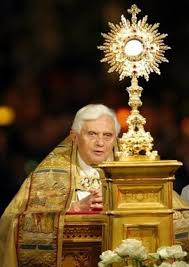
Pope Benidict“Eucharist as Blending One’s Existence.

The most profound content of Christian Eucharistic Piety is formulated as a standard of conduct.

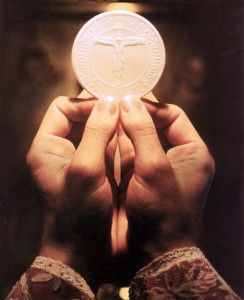
According to 1 Corinthians 6:12-19, receiving the Eucharist means: blending one’s existence closely, analogical, spiritually, to what happens when man and wife become one on the physical, mental, spiritual plane. The dream of blending Divinity with humanity, a breaking out of the limitations of a creature is here fulfilled.

Man’s promethean attempts to break out of his limitations himself, to build with his own capacities the tower by which he may mount up to Divinity, always necessarily end in collapse and disappointment, indeed in despair.  This blending, this union has become possible because God came down in Christ, took upon Himself the limitations of human existence, suffering them to the end and in the Infinite Love of the Crucified One opened up the door to Infinity.  The real end of Creation, its underlying purpose, and conversely that of human existence as Willed by the Creator is this very Union that ‘God may be All in all.’

True Crucifixion – True Resurrection

True Crucifixion:

V10 – Nov. 18, 1911 – “You Must Know that True Crucifixion does not consist of being crucified in your hands and feet, but in all the particles of your soul and body. Therefore, I keep you more crucified now than before. How long did the exterior Crucifixion of My Hands and Feet last? Only three hours. But the Crucifixion of All the Particles of My Being, and the Crucifixion of My Will in the Will of the Father lasted for My Whole Life. Don’t you want to Imitate Me in this too?”


True Resurrection:

V36 – April 20, 1938

How Jesus on the Cross still cries to every heart “I thirst.”  How the True Resurrection consists in Rising in the Divine Will.  How nothing is denied to one who Lives in It.

“…But do you want to know where is the Real Resurrection of the creature?  Not in the end of her days, but while she is still living on earth.  One who Lives in My Will Rises Again to Light and says: ‘My night is over.’  She Rises Again in the Love of her Creator, so that there is no more cold or snow for her, but the smile of the Heavenly Spring; she Rises Again to Sanctity, that puts in rushed flight all weaknesses, miseries and passions; she Rises Again to all that is Heaven, and if she looks at the earth, Heaven and sun, she does it to find the Works of her Creator—to take the opportunity to narrate to Him His Glory and His long Love Story.

 “Therefore, one who Lives in My Will can say, as the Angel said to the holy women on the way to the Sepulcher, ‘He is risen.  He is not here any more.’   One who Lives in My Will can also say, ‘My will is not with me any longer—it is Risen Again in the Fiat.’