Category: Uncategorized

Only 40 days ’till Christmas!

40 day countdown to Christmas Day

Thanksgiving (Nov 26),

Advent begins (Nov 29),

the Immaculate Conception (Dec 8),

Our Lady of Guadalupe (Dec 12),

St John of the Cross (Dec 14, for all you Carmelite Fans),

then Our Lord’s Birthday (Dec 25)

followed by the Feast of the Circumcision of Christ, the first drops of his innocent blood shed for humanity, on New Year’s Day!

Get Ready for the Christmas by praying the Christmas Novena!

Feast of Christmas

The Most Powerful Prayers

Volume 11 – June 15, 1916

In the Divine Will everything is complete.

The Most Powerful Prayers over the Heart of Jesus, and those which move Him the Most, are to clothe oneself with all that He Himself did and suffered.

Continuing in my usual state, my always lovable Jesus came, He Transformed me completely in Him, and then He told me:

“Daughter, pour yourself into my Will to make complete reparations for Me.

My Love feels an irresistible need for them; after so many offenses of creatures, it wants one at least who, placing herself between Me and them, would give Me Complete Reparations, Love for all, and would snatch from Me Graces for all. But you can do this only in My Divine Will, in which you shall find Me and all creatures. Oh, with what yearnings am I waiting for you to enter into My Divine Will, to be able to find in you the Satisfactions and the Reparations of all! Only in My Divine Will shall you find all things in act, because I AM engine, actor and spectator of everything.” Now, while He was saying this, I poured myself into His Divine Will – but who can say what I saw? I was in contact with every thought of creature, the Life of which came from God; and I, in His Divine Will, multiplied myself in each thought, and with the Sanctity of His Divine Will I repaired everything, I had a ‘Thank You’ for all, a Love for all. Then I multiplied myself in the gazes, in the words and in everything else – but who can say what was happening? I lack the terms, and maybe the very angelic tongues would stammer; therefore I stop here.

So I spent the whole night with Jesus in His Will. Then I felt the Queen Mama near me, and She told me:

“My daughter, pray.” And I: ‘My Mama, let us pray together, for by myself I don’t know how to pray.’

And She added: “The Most Powerful Prayers over the Sacred Heart of my Son, and those which move Him the Most, are for

the creature to clothe herself with everything He Himself did and suffered,

since He gave everything as Gift to the creature.

Therefore, my daughter,

“Surround your head with the thorns of Jesus, bead your eyes with His tears, impregnate your tongue with His bitterness, clothe your soul with His Blood, adorn yourself with His wounds, pierce your hands and feet with His nails, and like another Christ present yourself before His Divine Majesty. This sight will move Him in such a way that He shall not be able to deny anything to the soul who is clothed with His own insignia. But – oh, how little do creatures know how to make use of the Gifts which my Son gave them! These were my prayers upon earth, and these are my prayers in Heaven.”

So, together we clothed ourselves with the Insignia of Jesus, and together we presented ourselves before the Divine Throne.

This moved all; the Angels made way for us and remained as though surprised.

I thanked Mama, and I found myself inside myself.

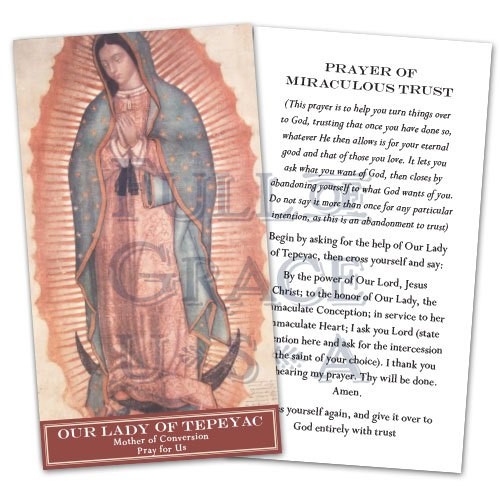
Prayer of Miraculous Trust

Prayer of Miraculous Trust

We all need prayer. In Catholicism, we speak of the communion of the saints, which means that all the faithful – both here and departed – are fully alive to God, and we have access to the faithful departeds’ prayers if we only ask. (for those who have any theological doubts on this point, please see Matthew 22:32, Mark 12:27 and Luke 20:38). But the prayers of the Church Militant, that is the faithful still on earth, for each other are crucial – and even more crucial in these times.

Right around the turn of the millennium, the archangel, Gabriel, gave me a prayer and told me the time would come when we would need miracles – and many miracles would be wrought through the faithful use of the prayer.

Right now, many things are collapsing before our very eyes.

When the normal means of healing are easily available, you should always take advantage of them. When God has provided abundant means of normal medicine, it is a presumption to demand only His supernatural medicine. Ideally, it is best to take advantage of both. But soon (and it is happening far more rapidly than I expected) availability of normal services will be spotty – and if you have something chronic or are elderly, much will not be available at all as surviving doctors start working under an implicit triage mentality because of the shortages of supplies and equipment. God will not leave you bereft.

Along with this posting I have linked to a religious supply house that has printed up thousands of prayer cards containing this prayer and instructions on how to use it. It is the Full of Grace Supply House which is also linked at the right hand of this page. The woman who owns it gave me most of them to give away. I always carry a supply with me. I asked her to carry them in her inventory, so that as many as possible might have access to them.

Now, if you treat these as some magic object, I have utterly failed my duty to you. There is no magic in the card, nor magic in the prayer. Rather, the instructions for the prayer teach you how to align your will with that of God. Having said that, there have been many startling results from the proper use of this prayer. Let me explain.

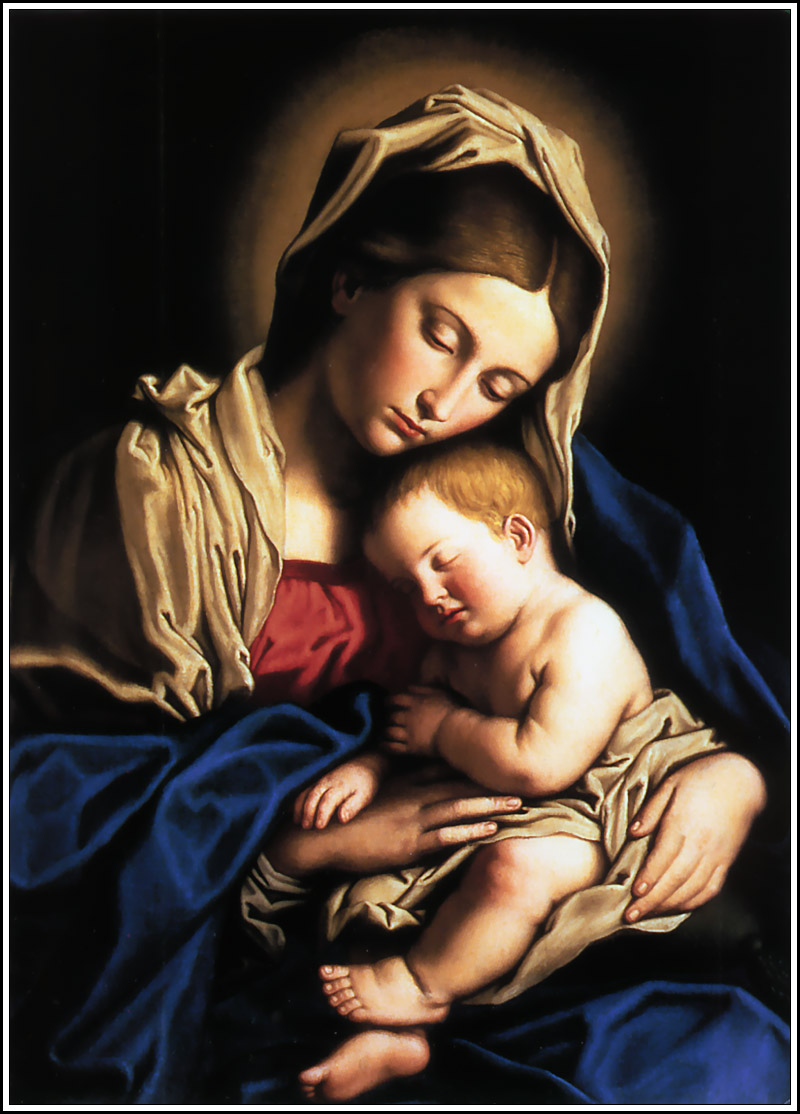
First, the Lord often acts to confirm His intentions. I tell you to acknowledge Our Lady of Tepeyac, which is Our Lady’s proper title in this image, though she is commonly called Our Lady of Guadalupe. I know this because she told me long ago. She is sent as the Mother of Conversion in these terrible times. It pleases Our Lord that you acknowledge, then spread devotion to His servant and mother in this role He has given her for these times.

Second, prayer must begin with faith, the knowledge that God is in control of all things. But it must not end there. The demons in hell know that Christ is Lord, they know Scripture better than you and all the greatest theologians combined and, as James said, they tremble because of that knowledge. If all you have is faith, you have nothing more than the demons in hell.

Faith must lead to trust, the trust that once you acknowledge and follow Him, whatever the Lord allows to befall you is for your benefit or instruction or that of another that you may give witness to, perhaps never knowing until judgment the witness you have given by your trust. Many Christians treat prayer as the cloth with which they rub the magic lamp to bind God to their will. Prayer is to bind you to God’s will – and to begin to understand it. That cannot happen unless you trust, knowing that His ways are not your ways. Some purported faith healers teach that God will always heal those who trust Him. They are right, but not in the way they think. Their imaginations are so impoverished that, whatever they say, the only good they can envision is of this world. God always heals for eternity – that you may have abundant life with Him in heaven. If that means you must suffer some here to quell your rebellious yearnings, than suffer you will – if you trust God. If you are a particularly useful soul, God may allow you to suffer in penance for others who do not know they need penance, that more might be saved. Trust.

Trust will lead to abandonment. That is giving yourself entirely and willingly to whatever God wants of you. Gabriel came to Our Lady, Holy Mary, and told her she would get a great honor if she accepted – become the mother of Our Lord in His human incarnation. But there was a catch, This would happen in a way that would subject her to shame and, perhaps even a brutal execution. What incredible faith, trust and abandonment she lived to be able to say almost immediately, “I am the handmaid of the Lord. Be it done unto me according to your word.” Of course, as Gabriel noted when he first spoke to her, she is “full of grace.” It is hard to get outside yourself. Some years ago, I was undergoing some serious suffering – and it would not go away. I begged and begged to know what I was doing wrong so I could correct it and escape my sorrows. Finally, the Lord, Himself came and said, “This is not about you.” Then He told me who it was about – someone I dearly loved who, unbeknownst to me, was in great spiritual danger. The Lord asked was I willing to accept this penance on the person’s behalf, for he desperately needed it. Foolish and self-centered as I was, I am proud I said yes – and soon was rewarded by seeing how much it was needed. Abandon yourself to His will – and don’t feel bad when He shows you what a silly, little fool you are. He only does that to those in whom He sees great promise. Be glad of your rebukes.

Finally, it is good to have prayer partners. It is even better to have one who already beholds the Face of God, for the saints’ faith is assured and will not fail. Take full advantage of the communion of the faithful. We are really going to need all hands on deck.

Know that with God, the intention is the action. Keep your prayers of petition short. It is not the length of them that aligns you with God, but the trust behind it. If you had perfect trust, all your intentions would merely be stated and then you would accept perfectly what God sends you. If you pray long in petition, you risk deluding yourself it is the Herculean nature of your efforts rather than the effortless grace of God that brings light, and thus become vainglorious. And yet, do not begrudge those who must make long, moaning prayers of petition. It is their lack of faith warring with their hope that makes it necessary. Such brevity is not for all prayer. Prayers of worship, praise and thanksgiving – and those that involve the will of another, may be said at great length, either privately or in community. Also, when a demon is involved, prayers of intercession may go for weeks, but that is best left to priests under most circumstances.

Do not say this particular prayer more than once for any specific intention. To do so is to fail in trust – and defeat the purpose of this prayer, which is abandonment to God’s will. Certainly, God knows how needy we are, so you may say other prayers for the same intention if the need arises, but not this one. In fact, following the lead of St. Monica, you should pray frequently on matters involving the will of another – but only once for this prayer, which is for abandonment to God. If you can, it is best to say it and then let it go, trusting that whatever comes of the matter now is for your eternal good regardless of what happens

Here are instruction and the text for the prayer:

A prayer to abandon yourself to trust in God; to bind yourself to His will with trust rather than trying to bind Him to yours. Pope Francis called Our Lady of Guadalupe the “Virgin of Tepeyac” at her last feast day. Tepeyac Hill is where she appeared, not Guadalupe, hence the title Our Lady of Tepeyac, Mother of Conversion. At its deepest level, this is a prayer that we all convert ourselves to God’s Holy Will.

Back of card: PRAYER OF MIRACULOUS TRUST: (This prayer is to help you turn things over to God, trusting that once you have done so, whatever He then allows is for your eternal good and that of those you love. It lets you ask what you want of God, then closes by abandoning yourself to what God wants of you. Do not say it more than once for any particular intention, as this is an abandonment to trust)

Begin by asking for the help of Our Lady of Tepeyac, then cross yourself and say:

By the power of Our Lord, Jesus Christ; to the honor of Our Lady, the Immaculate Conception; in service to her Immaculate Heart; I ask you Lord (state intention here and ask for the intercession of the saint of your choice). I thank you for hearing my prayer. Thy will be done. Amen.

Cross yourself again, and give it over to God entirely with trust.”

I saw a pithy saying last week I will end with: “Don’t worry about tomorrow. God is already there.”

http://www.fullofgraceusa.com/index.php?route=product%2Fproduct&product_id=327
You Need a Theology of Delayed Gratification!

“When we walk without the Cross, when we build without the Cross, and when we confess a Christ without a Cross, we are no longer disciples of the Lord. We are mundane. We are bishops, priests, cardinals, Popes, everyone, but we are no longer disciples of the Lord…do not be afraid of suffering.” Pope Francis I – given at his 1st Holy Mass as Pope

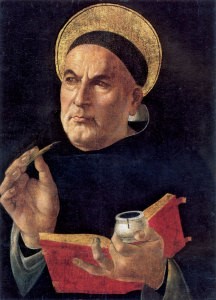
“Rational natures are poised between alternatives. God moves the human spirit to good; nevertheless, it could resist. It is God’s doing, then, that a man prepares himself to receive grace. If he lacks grace, then the cause of the failure lies in him, not in God.” Saint Thomas Aquinas


You Need a Theology of Delayed Gratification!

By Dr. Taylor Marshall

Learn to wait and delay good things…

Did you know that there is a connection between your child waiting for the prayer of blessing before meals and his ability to avoid premarital sex?

It has to do with delayed gratification:

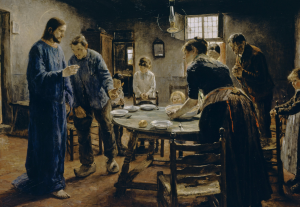
When we sit down at a meal, it is just and right that we first thank God and ask His blessing upon the food that we are about to enjoy. Then, and only then, do we pick up our forks and eat.

Little children are usually tempted to sneak a bite from their plates while mother is turned around getting the last dish on the table. It’s the duty of parents to stop this. The children must learn to wait. Why?

Meal ThanksWell one day their appetites will include not only food for preservation of the human body, but they will have an intense appetite for the preservation of the human race. Will they be allowed to nibble a little bit here and there before the blessing? In case you’re not following the analogy:

hungry child > dinner blessing > fulfillment of hunger appetite

young person > matrimonial blessing > fulfillment of sexual appetite

You see if Timmy learns that he can eat before the family is assembled and father leads in the religious blessing, well then, Timmy will not likely wait to have sex until after his family is assembled at church and Father has pronounced the religious blessing on Timmy’s bride and Timmy at the altar.

Are you following this?

Delaying Good Things for Good Reasons:

And this isn’t just about family meals. It’s about everything. School, jobs, Advent, Lent, the Eucharistic fast, fish Fridays, penance, sacramental preparation, childbearing, childrearing, illness, natural death, and so on and so on.

Catholicism is the religion of delayed gratification. This life is a test run to determine our eternal gratification. If we live only to have pleasure in the now, we won’t have beatitude in the future. Christ has instituted His Catholic Church to provide us with small mini-trials every day.

The Eucharistic fast is one obvious example. Humbling one’s self in the confessional before receiving the Holy Eucharist is another. It’s learning how to do something difficult or inconvenient for some other greater good.

Let’s go back to Timmy. If Timmy learns to break the Eucharistic fast or cheat his resolutions during Lent, what will he do in other areas of life? He’ll push the boundaries, but ultimately he’ll fail because he does not understand that all success derives from delayed gratification – both temporal and eternal.

Look at all these hipsters in America. They have college degrees. They vote. They are somewhat intelligent. They even own an interesting collection of vinyl records. Yet they do not have jobs.

It’s now being reported that our college educated hipsters are becoming dependent on state subsidies. They hang out in coffee shops discussing Renoir, Radiohead, and Rousseau, but they buy their groceries with food-stamps! It looks like they’ve fallen for the hipster trap.

What’s going on here?

These young people have been raised to reject delayed gratification. They are the products of society that glorifies immediate gratification  They want meaningful jobs…right now. They want to be art gallery directors, professors, CEOs, non-profit directors, film-directors, Facebook creators, authors, actors, and poets.

What they don’t see is that it takes a helluva lot of hard work to ascend to these professions.

This is why we must realize the value of Catholicism for our culture. Catholicism, in this regard, helps us in two ways: The first way is supernatural and the second way natural, temporal, and social.

  1. First, the Catholic theology of waiting confirms that the honors and accolades of this world are vanity of vanities. The Faith is what led the Holy Roman Emperor Charles V to resign his power and live his remaining days in an obscure monastery. The smaller natural pleasures of this life are not worth trading for the enormous supernatural beatitude to be attained in the next. This life itself is a prolonged wait for something better and beyond.
  2. Secondly, the theology of waiting or delayed gratification is not one of passivity. You are active and waiting. Unlike the ideology of hipsters smoking hand rolled cigarettes and complaining about those faceless stiff-shirts belonging to the “one percent,” the theology of waiting calls for sacrifice now for something better later. So if you want a meaningful job, get up off your skinny jeans and produce something. Contribute. Nobody cares about your thoughts and feelings unless they contribute to something. If you’re an artist, it may take you 20 years to actually sell something. If you can’t accept that, then don’t throw a tantrum and complain about the world. Learn a little delayed gratification. Write down your goals and realize that it takes a long time to reach important goals.

Contraception and Delay:

Contraception is the perfect example for our society’s desire for instant gratification. Contraception is the idea that you can have lots and lots of immediate pleasure (feels really awesome!) without committing to one person (a sacrificial act), and without committing to a pregnancy (a hugely sacrificial act), and without committing to raising a human person for eighteen years (an immensely sacrificial act).

Back to Timmy for one last time. From the time Timmy is born, he will be maintaining his “threshold for waiting.” He will observe the “threshold of waiting” in his parents. Do they live on a whim? Do they go into debt to have fun now? Are they penitential? Are they religious hypocrites? Then he will begin to see how the standard for the “threshold of waiting” is applied to him. Is he allowed to throw temper-tantrums when he is not immediately gratified. Will he persevere in household tasks? Will he finish homework? Will he keep the Eucharistic fast or will he sneak a cookie before Mass? Will he maintain simple customs such as not eating before the Blessing? You get the idea.

If Timmy does not learn this Catholic principle of delayed gratification, what will he become? He’ll become a contracepting hipster with a B.A. waiting for that $60,000 job to fall into his lap. Regrettably, he’ll be a nothing. Worst of all, he won’t live the abundant life that Christ promised for those who would take up their cross and follow Him.

Of course, it’s not easy to assume this theology of waiting. It is the most difficult teaching of Catholicism. As the Blessed Virgin Mary said to Saint Bernadette: “I promise to make you happy, not in this world, but in the next.” Those words terrify me. However, it is a sure promise. None of us will be perfectly happy in this life. It’s just not going to happen.

CS LewisC.S. Lewis once speculated that if God gave us perfect happiness in this life, it would be unjust since we would then stop seeking after God Himself. Saint Thomas Aquinas would say it is impossible to find happiness anywhere else since our Summum Bonum is none other than God Himself.

So don’t get down in the mouth about delayed gratification. It’s delayed…not never. Life won’t be perfect. Embrace this truth. There is freedom in it. There is joy in realizing it. Here the verse that wraps it all up nicely:

“But if you partake of the sufferings of Christ, rejoice that when his glory shall be revealed, you may also be glad with exceeding joy.” (1 Peter 4:13)

And another:

“But he that shall persevere to the end, he shall be saved.” (Matthew 24:13)

Godspeed,
Taylor R. Marshall

Aquinas. Please also explore Taylor’s books about Catholicism at amazon.com.

The post You Need a Theology of Delayed Gratification! appeared first on Taylor Marshall.

HOMILY OF HIS HOLINESS BENEDICT XVI -At the Shrine of Our Lady of Fátima

APOSTOLIC JOURNEY OF POPE BENEDICT XVI
TO PORTUGAL ON THE OCCASION OF THE TENTH ANNIVERSARY
OF THE BEATIFICATION OF JACINTA AND FRANCISCO,
YOUNG SHEPHERDS OF FÁTIMA

HOLY MASS

HOMILY OF HIS HOLINESS BENEDICT XVI

Esplanade of the Shrine of Our Lady of Fátima
Thursday, 13 May 2010


Dear Pilgrims,

“Their descendants shall be renowned among the nations […], they are a people whom the Lord has blessed” (Is 61:9). So the first reading of this Eucharist began, and its words are wonderfully fulfilled in this assembly devoutly gathered at the feet of Our Lady of Fatima. Dearly beloved brothers and sisters, I too have come as a pilgrim to Fatima, to this “home” from which Mary chose to speak to us in modern times. I have come to Fatima to rejoice in Mary’s presence and maternal protection. I have come to Fatima, because today the pilgrim Church, willed by her Son as the instrument of evangelization and the sacrament of salvation, converges upon this place. I have come to Fatima to pray, in union with Mary and so many pilgrims, for our human family, afflicted as it is by various ills and sufferings. Finally, I have come to Fatima with the same sentiments as those of Blessed Francisco and Jacinta, and the Servant of God Lúcia, in order to entrust to Our Lady the intimate confession that “I love” Jesus, that the Church and priests “love” him and desire to keep their gaze fixed upon him as this Year for Priests comes to its end, and in order to entrust to Mary’s maternal protection priests, consecrated men and women, missionaries and all those who by their good works make the House of God a place of welcome and charitable outreach.

These are the “people whom the Lord has blessed”. The people whom the Lord has blessed are you, the beloved Diocese of Leiria-Fatima, with your pastor, Bishop Antonio Marto. I thank him for his words of greeting at the beginning of Mass, and for the gracious hospitality shown particularly by his collaborators at this Shrine. I greet the President of the Republic and the other authorities who serve this glorious Nation. I spiritually embrace all the Dioceses of Portugal, represented here by their Bishops, and I entrust to Heaven all the nations and peoples of the earth. In God I embrace all their sons and daughters, particularly the afflicted or outcast, with the desire of bringing them that great hope which burns in my own heart, and which here, in Fatima, can be palpably felt. May our great hope sink roots in the lives of each of you, dear pilgrims, and of all those who join us through the communications media.

Yes! The Lord, our great hope, is with us. In his merciful love, he offers a future to his people: a future of communion with himself. After experiencing the mercy and consolation of God who did not forsake them along their wearisome return from the Babylonian Exile, the people of God cried out: “I greatly rejoice in the Lord, my whole being exults in my God” (Is 61:10). The resplendent daughter of this people is the Virgin Mary of Nazareth who, clothed with grace and sweetly marvelling at God’s presence in her womb, made this joy and hope her own in the canticle of the Magnificat: “My spirit rejoices in God my Saviour”. She did not view herself as a fortunate individual in the midst of a barren people, but prophecied for them the sweet joys of a wondrous maternity of God, for “his mercy is for those who fear him from generation to generation” (Lk 1:47, 50).

This holy place is the proof of it. In seven years you will return here to celebrate the centenary of the first visit made by the Lady “come from heaven”, the Teacher who introduced the little seers to a deep knowledge of the Love of the Blessed Trinity and led them to savour God himself as the most beautiful reality of human existence. This experience of grace made them fall in love with God in Jesus, so much so that Jacinta could cry out: “How much I delight in telling Jesus that I love him! When I tell him this often, I feel as if I have a fire in my breast, yet it does not burn me”. And Francisco could say: “What I liked most of all was seeing Our Lord in that light which Our Mother put into our hearts. I love God so much!” (Memoirs of Sister Lúcia, I, 42 and 126).

Brothers and sisters, in listening to these innocent and profound mystical confidences of the shepherd children, one might look at them with a touch of envy for what they were able to see, or with the disappointed resignation of someone who was not so fortunate, yet still demands to see. To such persons, the Pope says, as does Jesus: “Is not this the reason you are wrong, that you know neither the Scriptures nor the power of God?” (Mk 12:24). The Scriptures invite us to believe: “Blessed are those who have not seen and yet have come to believe” (Jn 20:29), but God, who is more deeply present to me than I am to myself (cf. Saint Augustine, Confessions, III, 6, 11) – has the power to come to us, particularly through our inner senses, so that the soul can receive the gentle touch of a reality which is beyond the senses and which enables us to reach what is not accessible or visible to the senses. For this to happen, we must cultivate an interior watchfulness of the heart which, for most of the time, we do not possess on account of the powerful pressure exerted by outside realities and the images and concerns which fill our soul (cf. Theological Commentary on The Message of Fatima, 2000). Yes! God can come to us, and show himself to the eyes of our heart.

Moreover, that Light deep within the shepherd children, which comes from the future of God, is the same Light which was manifested in the fullness of time and came for us all: the Son of God made man. He has the power to inflame the coldest and saddest of hearts, as we see in the case of the disciples on the way to Emmaus (cf. Lk 24:32). Henceforth our hope has a real foundation, it is based on an event which belongs to history and at the same time transcends history: Jesus of Nazareth. The enthusiasm roused by his wisdom and his saving power among the people of that time was such that a woman in the midst of the crowd – as we heard in the Gospel – cried out: “Blessed is the womb that bore you, and the breasts that nursed you!”. And Jesus said: “Blessed rather are those who hear the word of God and obey it!” (Lk 11:27-28). But who finds time to hear God’s word and to let themselves be attracted by his love? Who keeps watch, in the night of doubt and uncertainty, with a heart vigilant in prayer? Who awaits the dawn of the new day, fanning the flame of faith? Faith in God opens before us the horizon of a sure hope, one which does not disappoint; it indicates a solid foundation on which to base one’s life without fear; it demands a faith-filled surrender into the hands of the Love which sustains the world.

“Their descendants shall be known among the nations, […] they are a people whom the Lord has blessed” (Is 61:9) with an unshakable hope which bears fruit in a love which sacrifices for others, yet does not sacrifice others. Rather, as we heard in the second reading, this love “bears all things, believes all things, hopes all things, endures all things” (1 Cor 13:7). An example and encouragement is to be found in the shepherd children, who offered their whole lives to God and shared them fully with others for love of God. Our Lady helped them to open their hearts to universal love. Blessed Jacinta, in particular, proved tireless in sharing with the needy and in making sacrifices for the conversion of sinners.  Only with this fraternal and generous love will we succeed in building the civilization of love and peace.

We would be mistaken to think that Fatima’s prophetic mission is complete. Here there takes on new life the plan of God which asks humanity from the beginning: “Where is your brother Abel […] Your brother’s blood is crying out to me from the ground!” (Gen 4:9). Mankind has succeeded in unleashing a cycle of death and terror, but failed in bringing it to an end… In sacred Scripture we often find that God seeks righteous men and women in order to save the city of man and he does the same here, in Fatima, when Our Lady asks: “Do you want to offer yourselves to God, to endure all the sufferings which he will send you, in an act of reparation for the sins by which he is offended and of supplication for the conversion of sinners?” (Memoirs of Sister Lúcia, I, 162).

At a time when the human family was ready to sacrifice all that was most sacred on the altar of the petty and selfish interests of nations, races, ideologies, groups and individuals, our Blessed Mother came from heaven, offering to implant in the hearts of all those who trust in her the Love of God burning in her own heart. At that time it was only to three children, yet the example of their lives spread and multiplied, especially as a result of the travels of the Pilgrim Virgin, in countless groups throughout the world dedicated to the cause of fraternal solidarity. May the seven years which separate us from the centenary of the apparitions hasten the fulfilment of the prophecy of the triumph of the Immaculate Heart of Mary, to the glory of the Most Holy Trinity.