Category: Uncategorized

Luisa sends Easter wishes

  1. To Mother Cecilia

In Voluntate Dei!

My good and reverend Mother,

(…) Now I feel the need to send you my Easter wishes.  My Mother, what wish can I send you?  I know that crosses surround you; how many times you have to swallow bitter pills, that make your heart bleed.  It seems to me that dear Jesus surrounds you with these pains in order to give you strength, and with tender and loving voice, He says to you:  “My daughter, give these pains to Me, that they may form my arms, my heart, my steps – my whole Life, to be able to live within you.”  My Mother, it is the crosses, the sufferings united to the Divine Volition, that form the raw material in order to receive in us the life of Jesus, Who calls our littleness to live in Him and to rise in Him.

Here is my wish, my Mother:  to rise not only on Easter, but continually in Jesus; so that every pain and each one of our acts, may be the means in order to rise in the One Who loves us so much.  I believe I could not send you a more beautiful wish; and I believe you will appreciate it, more so, under the rain of unheard-of crosses and of profound humiliations.  The storms give no sign of ceasing.  Pray that He will make peace rise again from the storms, otherwise one cannot live.

My sister tells you many things and sends you her affectionate wishes.  In a special way, I send my wishes to Sister Remigia, that she may form her perfect resurrection in the Divine Will, and use every act does in order to grow in sanctity.  We must be convinced that not the great things make us saints, but the little ones, which we have in our power and which serve as the nourishment of sanctity.  I commend myself to your prayers, and leaving you rising together with Jesus, I kiss your right hand and with a thousand regards, united to my sister, I say,

The little daughter of the Divine Will.

Corato, April 5, 1939


  1. To Mrs. Mazari, from Bari

J.M.J.

Fiat!

My good daughter in Jesus Christ,

Do not get discouraged, never lose trust.  What I recommend is that you look at your crosses as many visits from Jesus, Who brings you the life of the Divine Will, to make It reign in you and to give you all His love as food; to make you grow in His likeness within His arms, and to make of you such a rare beauty as to enrapture even Himself.  If you do the Will of God, you will feel a strength in all your sufferings; you will feel an invisible hand which helps you, guides you, and does whatever you do within you.  In fact, when one does the Will of God, the work is more of God than ours.  Therefore, I wouldn’t know what else to say:  do the Divine Will; live in It, and you can be sure that you will make yourself a saintYou will feel the bond and the association with the Divine Family.  What is Theirs will be yours.  So, banish fear and fright, and all the most painful circumstances will bring you the kiss, the strength – the life of the Divine Will, embalmed by Its love and joy.

Tell good Carmela to have patience.  Jesus loves her so much that He looks at her continuously, and with the brush of sufferings in His hands, He paints her, to make of her a more beautiful image, so that she may be like Him.

I send you my wishes of good Easter:  let the Divine Will rise again in you.  I leave you in the Divine Volition to make yourself a saint, that the earth may no longer be earth for you, but Heaven. 

Pray for me.  And greeting you from my heart, I say,
Most affectionately yours,

The little daughter of the Divine Will.


1865 – Luisa Piccarreta was born on April 23, the Sunday after Easter, in Corato, Bari, to Nicola Vito and Rosa Tarantino, who had five daughters: Maria, Rachele, Filomena, Luisa and Angela.

A few hours after Luisa’s birth, her father wrapped her in a blanket and took her to the main church for baptism. Her mother had not suffered the pangs of labor: her birth was painless.

1872 – She received Jesus in the Eucharist on the Sunday after Easter, and the sacrament of Confirmation was administered to her on that same day by Archbishop Giuseppe Bianchi Dottula of Trani.

The Mass and the resurrection of our bodies to glory

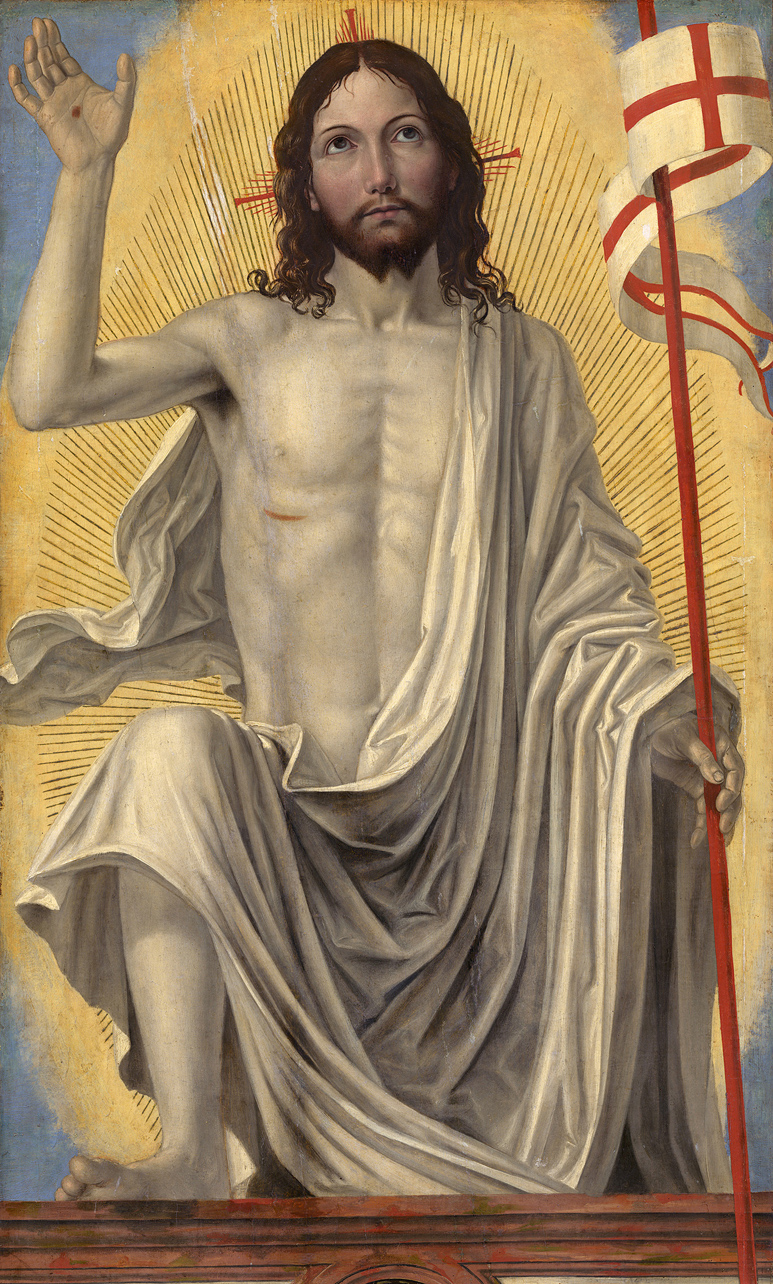
The Resurrection is depicted in "Christ Risen from the Tomb," a painting by Italian Renaissance artist Bergognone. The artwork is from the Samuel H. Kress Collection at the National Gallery of Art in Washington. Easter, the feast of the Resurrection, is April 8 in the Latin-rite church this year. (CNS photo/courtesy of the National Gallery of Art) (March 27, 2012)

HE IS RISEN INDEED

ALLEULUIA!


From Luisa in 1899, before she received the full understanding of  her mission to the Church and world in the Divine Will

Now, while seeing Jesus or the priest celebrating the Divine Sacrifice, Jesus would make me understand that in the Mass there is the whole depth of our sacrosanct religion.  Ah! yes, the Mass tells us everything and speaks to us about everything.  The Mass reminds us of our redemption; It speaks to us, step by step, of the pains that Jesus suffered for us; It also manifests to us His immense love,image315 for He was not just content with dying on the Cross, but He wanted to continue His state of victim in the Most Holy Eucharist.

The Mass also tells us that our bodies, decayed, reduced to ashes by death, will rise again on the day of the judgment, together with Christ, to immortal and glorious life.  Jesus made me comprehend that the most consoling thing for a Christian, and the highest and most sublime mysteries of our holy religion are:  Jesus in the Sacrament and the resurrection of our bodies to glory.

These are profound mysteries, which we will comprehend only beyond the stars; but Jesus in the Sacrament makes us almost touch them with our own hands, in different ways.  First, His Resurrection; second, His state of annihilation under those species, though it is certain that Jesus is there present, alive and real.  Then, once those species are consumed, His real presence no longer exists.  And as the spe8cies are consecrated again, He comes again to assume His sacramental state.

So, Jesus in the Sacrament reminds us of the resurrection of our bodies to glory:  just as Jesus, when His sacramental state ceases, resides in the womb of God, His Father, the same for us – when our lives cease, our souls go to make their dwelling in Heaven, in the womb of God, while our bodies are consumed.  So, it can be said that they will no longer exist; but then, with a prodigy of the omnipotence of God, our bodies will acquire new life, and uniting with the soul, will go together to enjoy the eternal beatitude.  Can there be anything more consoling for a human heart than the fact that not only the soul, but also the body will delight in the eternal contentments?

It seems to me that, on that day, it will happen as when the sky is starry and the sun comes out.  What happens?  The sun, with its immense light, absorbs the stars and makes them disappear; yet the stars exist.  The sun is God, and all the blessed souls are stars; God, with His immense light, will absorb us all into Himself, in such a way that we will exist in God, and will swim in the immense sea of God.  Oh! how many things Jesus in the Sacrament tells us; but who can say them all?  Truly, I would be too long.  If the Lord allows it, I will reserve saying something else on other occasions.

THE SUN OF MY WILL – PREFACE AND AFTERWORD

The book THE SUN OF MY WILL Luisa Piccarreta

An Ordinary Life Outside The Ordinary

from the Vatican by MARIA ROSARIA DEL GENIO

Preface by Cardinal JOSE SARAIVA MARTINS

Prefect emeritus of the Congregation for Saints’ Causes


PREFACE

“We are living in a time of mercy.” Meeting with parishioners in Rome March 6, 2014, Pope Francis has no doubt about how to define our era, so tormented by conflicts of every kind: “a time in which God shows us a greater Love.” It is an affirmation that is only understandable according to divine logic, which astonishingly opposes the sin of mankind with a larger tolerance and a disarming declaration of trust in His creatures.

Certainly, every page of the Bible speaks to us about His extraordinary benevolence. Where it shines with greater intensity, however, is precisely on the cross of the Son of God. As Pope Francis said in his homily on March 24, 2013, “Jesus takes upon Himself the evil, the filth, the sin of the world, including the sin of all of us, and He cleanses it, He cleanses it with His blood, with the mercy and the love of God. Let us look around: how many wounds are inflicted upon humanity by evil! Wars, violence, economic conflicts that strike the weakest through greed for money, … power, corruption, divisions, crimes against human life and against creation! And – as each one of us knows and is aware – our personal sins: our failures in love and respect towards God, towards our neighbor and towards the whole of creation. Jesus on the cross feels the whole weight of the evil, and with the force of God’s love He conquers it, He defeats it with His resurrection.”

It is a victory that does not end “at daybreak on the first day of the week” in Jerusalem. It is repeated in each one of us every time we decide to live the “first day” of a life that is wholly renewed by God’s love through the joyous encounter with the Risen Jesus, who always sets out to encounter us. In this sense, mercy is an appeal to return to God with courage; having faith in His patience and infinite tenderness. Every moment God is inviting people to this encounter of rebirth in Him. Throughout the history of humankind there is no lack of examples – some striking as well – of people courageously turning back to God.

The entire Church is encouraged by Her Lord, first of all, to respond continually to His appeal of mercy and, at the same time, to proclaim it to the men and women of every age. After all, the call to come back to God is as everlasting as the impulse to go out of oneself to carry out the Church’s mission of evangelization. The image Pope Francis uses in his Apostolic Exhortation Evangelii Gaudium is beautiful: to be people who are an amphora – a vessel holding water – called to quench the thirst of those in the spiritual desert of our time. He wisely adds that “at times, the amphora becomes a heavy cross, but it was from the Cross, from his pierced side, that our Lord gave Himself to us as a source of living water” (sec. 86).

Certainly among these “amphora-people,” one cannot but contemplate the testimony of the saints who, since time immemorial, have illuminated the path for humanity. By rereading their lives in the paschal light, this mysterious connection emerges between personal suffering and “communal” fecundity. One sees in them the “much fruit” generated by dying to themselves and to their own wills!

The profound testimony of Luisa Piccarreta also shows us this dynamic that is so typical of God’s mercy and that draws people to the deepest unity with Him in order to transform the heart into a gushing spring of water to benefit everyone. Thus, in her simple life as a lay woman who worked making lace, bound to the Church by an adamant obedience to her confessors, one sees her nailed to her bed of suffering for about 70 years in order to create a magnificent masterpiece of love for all creatures.

From her continual contemplation of Jesus’ passion, Luisa is led to conform herself to Christ, to the point of offering herself with Him to the Father for the benefit of all humanity. She learns from the book of the Cross that the Will of God is not about carrying out orders received, but a gift in which one must place, before all else, the center of one’s life. This “living in the Divine Will” is the actual way in which the Son Jesus lived on earth, bringing here with him the life of Heaven. Pope Benedict XVI also recalled this in a passage of his Encyclical Letter Deus Caritas Est when he affirmed: “The love-story between God and man consists in the very fact that this communion of will increases in a communion of thought and sentiment, and thus our will and God’s will increasingly coincide:

God’s will is no longer for me an alien will, something imposed on me from without by the commandments, but is now my own will, based on the realization that God is in fact more deeply present to me than I am to myself Then, self-abandonment to God increases and God becomes our joy (cf. Ps 73 [72]:23-28)” (sec. 17).

Living this way means that even our smallest act in life takes part in the dynamic of mercy, contributing with Jesus to bring His light to all hearts – and to God – all the praise and adoration that everyone ought to give Him.

This petite woman from Southern Italy – who experienced a succession of various epidemics, two wars and who dried many tears shed because of the difficult living conditions of the people around her – transformed her entire heart into a dwelling place for God alone. Those who met her felt drawn to the truth of Heaven and compelled to live a life of holiness, a life spent entirely engaged in ordinary everyday activities, modeled after the family of Nazareth.

And it is precisely in the everyday that God’s mercy seeks out humanity – to restore to them the innocence of Eden – to a life filled with joy and to an existence guided by the certainty of being God’s beloved children.

           Rome, April 23; 2014

Anniversary of the birth of the Servant of God Luisa Piccarreta

Cardinal JOSE SARAIVA MARTINS, C.M.F.

Prefect emeritus of the Congregation for Saints’ Causes


Afterword by Archbishop

GIOVAN BATTISTA PICHIERRI

Archbishop o/ Trani-Barletta-Bisceglie and Nazareth

LIBRERIA EDITRICE VATICANA

AFTERWORD

The publication of this first documented biography of the Servant of God Luisa Piccarreta is both a final achievement and a new point of departure. After the conclusion of the Diocesan investigation into the life, virtues and fame of holiness on October 29, 2005 in the presence of hundreds of faithful from many parts of the world, I was already keenly aware of the need to have an expanded biographical profile that could present the multi-faceted figure of this lay Dominican from our archdiocese. A video documentary was produced titled, “Dawn of a Mystery,’’ translated from the original Italian, “Alba di un mistero,’’ into various languages, with the aim of being an introduction to Luisa’s life and her spirituality of “living in the Divine Will.” Subsequently, on the occasion of the 60th anniversary of her death, the publication of the small book Giorni di Luce (Days of Light) focused attention on the event of her funeral and the impact it already had beyond Corato at the time.

Nevertheless, it is only thanks to Maria Rosaria Del Genia’s valuable research and study that it has been possible to reconstruct, in an organic framework and historical context, the servant of God’s journey of life and faith.

I thank the public association of the faithful, “Luisa Piccarreta Association – Little Children of the Divine Will,’’ for having supported the project of this publication – an essential means of raising and spreading awareness that is now being offered to everyone. What emerges most of all is a markedly strong religious profile of Luisa and her unbroken relationships with the archbishops and the priests appointed for her spiritual guidance. Reading this skillfully narrated story, one gathers that Luisa’s secluded life did not keep her from sharing deeply, within her abilities, the historical events of her time. One could say, she almost lived them as the protagonist even if it was on a transcendental plane. But what is amazing is how close she is to the people. Her mystical experience does not distance her at all from life’s everyday struggles during a period of great economic and social difficulties. Though she sought to stay out of sight, she realizes that she cannot remove herself from a public mission that unfolds in her countless personal encounters with all those who visit her. She also takes advantage of her handiwork – which she never abandoned – to become a teacher of the craft of lace making and also of God’s love. She never gives up on anyone who is going through a difficult time and, if necessary, she reaches out to them with her letters full of intimate assurance and hope;

This biography, as I said, is also a point of departure – first of all, for those who have been familiar with Luisa Piccarreta for a long time. Her life will be able to help them understand better the message she carried. By reflecting on her daily actions and the essential focal points of her spiritual life, such as – sustained nourishment from the Eucharist; obedience to her confessor; unceasing invocations in prayer; and charity toward those most in need people will be inspired to follow in her footsteps, according to God’s Will for each person.

However, those in the world who will benefit most of all will be people who have heard just a little bit about her life and, drawn to her spirituality, have asked for information and resources that go into greater depth.

Therefore, this book intends to be of service so that the mes sage of the “Divine Will” shines throughout the whole world, in fidelity to the truth about Luisa’s life and in communion with the Catholic Church. It is that Church to which the servant of God intended to surrender herself and to all that the Holy Spirit gave her to understand about the “fiat voluntas tua sicut in caelo et in terra” (“Your kingdom come, Your will be done, on earth as in heaven’’) (Mt 6:10).

It is no mystery that this proclamation has struck a chord in so many different countries in the world and that so many faithful have found a reason to renew their faith and for many others to rediscover it. Any personal spiritual deepening is almost always accompanied by a communal journey with prayer groups, often guided by a priest or, in any case, in communion with the local bishop of the diocese involved.

In some cases the bishops themselves have organized the groups that are present in their dioceses, guaranteeing that their formation be in light of Church doctrine with an itinerary of study and a sacra mental Christian life.

A source of great wonder is the vitality evident in groups that are thousands of miles from Corato – in lands where Christianity is still very new. I am thinking about those groups in South Korea or the many groups in the Philippines and the outreach taking place in Australia. One cannot forget the many groups in the United States, Mexico and many other countries in Central and South America, as well as all the news from the faithful in Costa Rica, Nicaragua, Colombia and Venezuela, for example.

Often I ask myself the reason for such participation and why it has spread so far and wide. Undoubtedly God’s plans often take us off guard and leave us astonished. It is a plan that has been carried out for many years, thanks to the tireless work of priests, laypeople and consecrated men and women who, after having come into contact with Luisa Piccarreta’s spirituality and without ever having had the chance to know her personally, have dedicated themselves to spreading the message that set their hearts on fire. This has not been an organized and coordinated strategy, but a “movement” that sprung up naturally on its own accord and that, in many different ways, gave rise to what can be defined as the “family of little children of the Divine Will” in the world. As bishop of the diocese that looks after the historical memory of Luisa, my constant invitation is for all people to live in unity and ecclesial communion and to feel part of one plan alone – partners in a plan that God wants to carry out in the Church for the benefit of all of humanity.

With The Lord’s Prayer, all of us must pray for the coming of the Divine Kingdom – the fulfillment of God’s Will on earth as it is in heaven. By inviting us to participate in His love through the gift of the Holy Spirit, Jesus asks us, just as He did with Luisa, to embrace heaven and earth together. In that way He lets us share, through His humanity, in all the heavenly gifts He possesses and that He wishes to give to every person.

To the extent to which we submit ourselves to this call and are removed from all personal self-interest or biases, the Divine call that Jesus gave to Luisa to “live in his Divine Will” will be able to bear the fruits of holiness in many hearts that are often closed up in sadness and locked in the illusion of a life without God.

In order to help these hardened hearts, the archdiocese and the association are promoting her cause for sainthood, letting this gift be more widely known in the Church – the gift safeguarded in this little creature who lived in the simplicity of her faith. In addition, they have begun working on a critical edition of her writings in order to offer greater assurance to the faithful who value the importance of these writings for their spiritual growth. In fact, even though they may have been motivated by good intentions, many tried to create transcripts, translations and publications that have often been found not to correspond to Luisa Piccarreta’s original writings. In specific cases, even some independent translations have fomented false interpretations and misleading doctrines of which no trace can be found in Luisa’s life and thought. An authentic dissemination can never neglect the authenticity of the message and, therefore, the content one wants to spread far and wide. If one distributes writings whose conformity to the original cannot be guaranteed, no real dissemination would ever be achieved. On this point, my constant invitation is to be prudent and to adhere to what is gradually being done with the typical and critical edition of the servant of God’s writings. It is a complex task that must be supported in every way and, most of all, by praying for those who are carrying it out.

Moreover, I am convinced that spreading her way of life can never be disconnected from proper formation which is ministered in communion with the Catholic Church and is integrated with all aspects of Christian life.

Knowledge of this exalted spirituality must not close us up and turn into sterile spiritual self-reflection, but must open us up to our brother or sister who walks by and in whom we often recognize the cry of Jesus Himself, who dwells in us and wants to be reciprocated with His own love. After all, it is what Luisa did her entire life by continually offering herself as victim on behalf of everyone. It is not surprising then that initiatives aimed at the social development of the poorest have also blossomed in many groups dedicated to the Divine Will.

Luisa’s work is certainly still far from losing its impact. This can also be seen with the ample news about graces received through her intercession and that the Postulation of the cause for her beatification is diligently gathering and examining. Even more evidence is seen in the stream of visitors to the city of Corato, Luisa’s birthplace. But most of all, it is evidenced by the fact that so many people naturally turn to Luisa of their own accord, as they did long ago, to ask to be accompanied along their life’s journey with the confidence that they will be led to God.

All of this requires that we collaborate, each one contributing his or her part, so that God’s Will is done on earth as in heaven.

          Archbishop GIOVAN BATTISTA PICHIERRI

          Archbishop of Trani-Barletta-Bisceglie and Nazareth
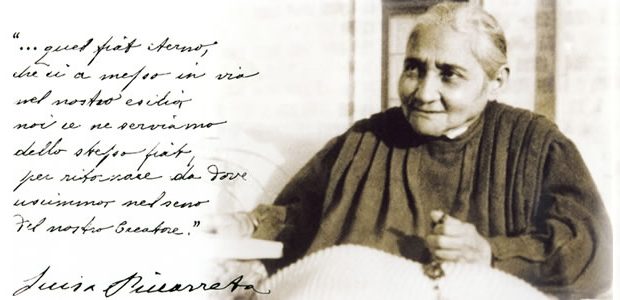
 

Prayer of Jesus

July 1, 1924 The prayer of Jesus.

      “My daughter, let us pray together.
     There are certain sad times in which my Justice, unable to contain Itself because of the evils of creatures, would want to flood the earth with new scourges; and so prayer in My Divine Will is necessary, which, extending over all, places itself as defense of the creatures, and with its power, prevents My Justice from approaching the creature to strike her.”
  

     How beautiful and touching it was to hear Jesus pray! And since I was accompanying Him in the sorrowful mystery of the Scourging, He made Himself seen pouring out Blood, and I heard Him say:

     “My Father, I offer You this Blood of Mine.

     O please, let It cover all the intelligence’s of creatures,

rendering vain all their evil thoughts, dimming the fire of their passions,

and making holy intelligence’s rise again.

May this Blood cover their eyes and be a veil to their sight,

so that the taste of evil pleasures may not enter them through their eyes,

and they may not get dirty with the mud of the earth.

May this Blood of Mine cover and fill their mouths,

and render their lips dead to blasphemies,

to imprecations, to all of their bad words.

My Father, may this Blood of Mine cover their hands,

and strike terror in man for so many evil actions.

     May this Blood circulate in Our Eternal Will in order to cover all,

to defend all, and to be a defending weapon for the creature

before the rights of Our Justice.”
Amen!

Storm Heaven with Cardinal Burke: March 1st & March 4th

Rosary Warriors…
Storm Heaven with Prayer!

His Eminence Raymond Cardinal Burke will be celebrating the Holy Mass and, afterwards, praying the Holy Rosary to Storm Heaven with Prayer tomorrow morning, 1st of March, at 11:00am in Rome, for your intentions and the intentions of Operation Storm Heaven.

I am writing to remind you, my fellow Rosary Warrior, that tomorrow we band together from the four corners of the earth to raise our united voice to Heaven. Tens of thousands of Rosary Warriors will be reciting the Holy Rosary and storming Heaven with Prayer in union with the Holy Mass being celebrated in Rome by Cardinal Burke.

You do not need to pray at exactly the same time, but please pray your Rosary at some time on the 1st of March (your local time). We are providing the Mass time for those who wish to pray at exactly the same time as Cardinal Burke celebrates Mass and prays the Rosary in Rome.

When you pray your rosary tomorrow, March 1st, please remember to pray for the intentions of all the Rosary Warriors, just as they are also praying for your intentions.

“The Rosary is THE weapon!”, stated St. Padre Pio. Let us continue to employ this powerful weapon to storm Heaven and ask God and the Blessed Virgin Mary for the following intentions:

  • For Holy Mother Church: that Our Lord guide the Pope, the bishops and all members of the clergy to be holy in all things, faithful shepherds, beacons of Truth, and defenders of Good;
  • May all confusion be dispelled from the hearts and minds of all people and may the Light of Truth shine in them;
  • For our families and the family institution that is being so attacked in our world;
  • For the conversion of all sinners to the True Faith;
  • For the salvation of my soul, the souls of my loved ones, and the souls of all;
  • For the sanctification of each and every Catholic, especially for my personal sanctification. May I live holy every moment of every day of my life. May I be a true follower of Jesus Christ in all things;
  • To make each and every one of us a faithful soldier of Christ in the struggle against the world, the flesh and the devil;
  • To obtain the graces necessary to stop abortion, stop the onslaught of the homosexual revolution, to overturn legalized same-sex marriage, to stop the spread of physician-assisted suicide and euthanasia, and to stop the culture of death in all its forms and establish the Culture of Life in all souls, in all minds and in all hearts;
  • For our beloved Nation and for every nation on earth;
  • For all the personal intentions that have been submitted to ‘Operation Storm Heaven’

Let us continue to ask God to have mercy on all those who have fallen away from the True Faith. May He open the floodgates of Mercy, through the intercession of Mary Most Holy, the Mother of Mercy, and bring these lost sheep back to the Catholic Faith.

As we endeavor to spread this initiative and enlist more Rosary Warriors to join Operation Storm Heaven, please share this with your family and friends and anyone who you think would like to participate in this History-changing campaign to storm Heaven with prayer to obtain a tidal wave of mercy from God for our families, our society, our country and the world…in short, for all souls!
May Our Lady of the Rosary bless you and your loved ones!
Your fellow Rosary Warrior in Christ,
Thomas J. McKenna
Founder and President
http://www.catholicaction.org/

From Luisa Piccarreta Association Luisa Piccarreta Official Website – “Lady” Obedience


February 28, 1899:
“Lady” Obedience wins over Luisa!

2/26/2016
The word “obedience” is often misunderstoodWeb Pick, because we highlight a negative feature of the relationship among people, rather than its divine feature that is true, eternal and positive.

“Obey” comes from the Latin roots ob+ audire meaning to listen closely.

So “obedience” must not be regarded as a passive zeroing of man’s will, such as a annihilation of his freedom, but as its exaltation, because it triggers the deeper mechanisms of listening and dialogue.

“Behold, I come to do your will” (Heb 10:9)

“Christ became obedient unto death, even death on a cross” (Phil 2:8)
Biblical evidences shows that Jesus is certainly aware of the dramatic end to which he freely gives Himself, in fulfilling the mission received from the Father. Jesus several times expresses the belief that adherence to God’s will, in the establishment of the Kingdom among men, involves the price of loyalty until death. The free decision of Jesus is caused by his bond of loyalty and obedience in the love of the Father which is expressed in his unconditional love for men.

Moreover Jesus is the One who accomplished it and gave testimony about it: “Son though he was, he learned obedience from what he suffered; and when he was made perfect, he became the source of eternal salvation for all who obey him” (Hebrews 5: 8-9). Any plan for our salvation depends on a free and responsible exercise of obedience; In fact what is sin, if not a disobedience to God’s command?

Jesus in one of his talk with Luisa said that Obedience was everything for Him, Obedience made Him be born, obedience made Him die. The wounds He had on his body were all wounds and marks that obedience made to Him. Through her Jesus conquered death, He defeated hell, He released man from his chains, He opened Heaven; and like a victorious King, He took possession of His Kingdom, not only for Himself, but for all his children.

Obedience is the quintessence of love; obedience is the finest, the purest, the most perfect love, extracted from the most painful sacrifice, to destroy oneself in order to live again of God.

Being most noble and divine, obedience tolerates nothing human in the soul, and nothing which does not belong to it. Therefore, all its attention is on destroying within the soul everything which does not belong to its divine nobility – that is, love of self. And once it has done this, it cares very little about whether it alone struggles and toils on behalf of the soul, while allowing the soul to rest peacefully.

Oh, holy obedience! How strong and powerful you are!
I see you before me, in these days of martyrdom, like a most powerful warrior,
armed from head to foot with swords, darts and arrows;
filled with all those instruments which are apt to wound.
And when you see that my poor heart, tired and down, wants to be cheered,
searching for its refreshment, its life,
the center to which it feels drawn as by a magnet
looking at me with a thousand eyes, you wound me from all sides with mortal wounds.
O please, have pity on me, and don’t be so cruel with me!
But the name ‘obedience’ resounds sweetly to your hearing,
and this is why you have so much love for obedient souls”.
Luisa Piccarreta

FIAT

St. Veronica Giuliani -Mystic, Stigmatic, Victim Soul, Incorruptible

St. Veronica Giuliani

St. Veronica Giuliani -Mystic, Stigmatic, Victim Soul, Incorruptible

About Her Diary
St. Veronica left us a spiritual treasure, her Diary, which she wrote under obedience to her confessor, Fr. Gerolamo Bastianelli. She began writing it in April, 1693 and finished writing it thirty four years later in 1727. She wrote a total of twenty-two thousand pages. This was a great penance for her. She did not neglect her other duties and would write late at night in her cell. The devil would often try to scare her to disrupt her writing. He would hide and break her pencils, and sometimes even attacked her physically: “After Matins, when I wanted to make an act of obedience and write for a quarter of an hour, I suddenly got a big punch in the eye and heard a voice saying, ‘damned writings!’” During the last fifteen years of her life, Veronica was so ill that a painting of Our Lady of Sorrows in her cell would come to life, and the Blessed Virgin Mary herself dictated to her the last chapters of the Diary.

Jesus made two promises to Veronica about this diary: “The Lord himself made me understand I should write everything; because He wanted it thus; and that these writings would be of great benefit to many souls; and that he wanted it to be for the whole of Christianity.” And on another occasion Jesus told her: “I inform you that I want to give special graces to whomever will trouble himself with this work. And I want everything, everything revealed. These are My works, My gifts, they are My singular graces, and all shall be for My glory.”

It is interesting to note that both saints and mystics have been entrusted with the publication of this diary. It was not until one hundred and fifty years later that Francois Dausse started to work on its publication, but his work remained unfinished because of his death. After this, St. Annibale Maria di Francia started working on this diary and managed to publish the first volume under the title, A Hidden Treasure, The Diary of St. Veronica Giuliani (1891-92). However, St. Annibale had to stop working on this Diary because the local Bishop asked him to start reviewing the writings of mystic, Luisa Picarreta in order to give them the Nihil Obstat and Imprimatur. Later, a Jesuit priest, Pietro Pizzicaria, managed to publish the next 8 volumes under the same title before he died and the last two volumes were published by Professor Umberto Bucchioni in 1927.